Introduction: why Cloud sustainability can’t wait
At a time when public cloud usage is ever increasing due to Generative AI demand it is essential to understand its environmental impacts. The Sixth Intergovernmental Panel on Climate Change (IPCC) Report confirms humanity’s decisive role in these crises. Seven of the nine planetary boundaries have already been transgressed, including ocean acidification in 2025.
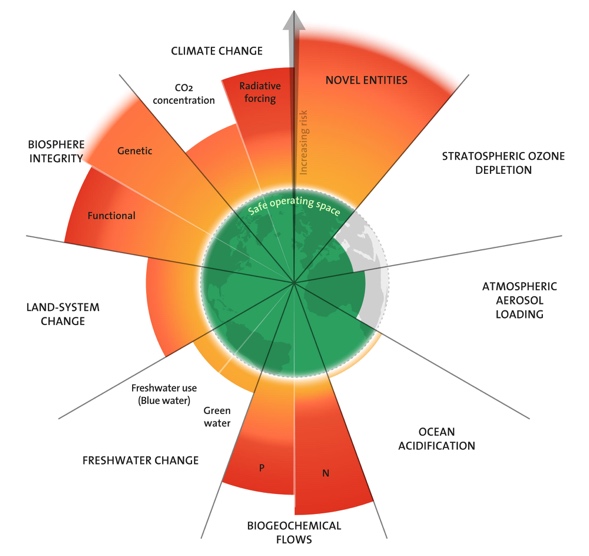
The Information and Communication Technology (ICT) sector is a significant contributor, accounting for between 1.8% and 2.8% of greenhouse gas (GHG) emissions in 2020. In 2023, the sector consumed 27% of the carbon budget associated with the climate change planetary boundary and 18% of the boundary for mineral and metal resource use. While the ICT direct environmental footprint encompasses user equipment, networks, and datacentres, datacentres represent a substantial portion, estimated at 20-30% of the total ICT impact. Furthermore, this share is increasing, mainly driven by the growing demand for cloud services and Generative Artificial Intelligence (GenAI) applications.
Defined as computing resources delivered over the internet by third-party providers, public cloud services allow users to access shared resources without owning physical equipment. This paradigm encompasses various service layers, from Infrastructure-as-a-Service (IaaS) to Software-as-a-Service (SaaS), and promotes hardware optimisation and economies of scale, fuelling a market projected to grow annually by 15% through 2030.
However, this projected expansion comes with an important energy cost. The International Energy Agency (IEA) estimates that global datacentre electricity consumption will more than double, rising from approximately 415 TWh in 2024 to 950 TWh by 2030, a trajectory significantly accelerated by energy-intensive applications like GenAI.
Despite the urgency of better mitigating these environmental impacts, assessing the footprint of cloud services is a complex task in the current ecosystem. Major providers like AWS, Google, and Microsoft use diverse and opaque methodologies, making their carbon claims incomparable. Standardisation initiatives are not prescriptive or exhaustive enough to cover the diversity of services and provide comparable results. Third-party tools (e.g., BoaviztAPI, Cloud Carbon Footprint) offer transparency but lack critical infrastructure parameters, until now.
Another key challenge in environmental impact assessment of cloud services relies in the way services are provided. By definition, the public cloud operates as a “black box”: users delegate and do not manage the underlying infrastructure, rendering direct physical measurement impossible and forcing reliance on models and assumptions. Furthermore, the mutualisation of equipment across various clients and services requires the definition of allocation keys to distribute environmental impacts, introducing significant additional uncertainty into impact assessments.
The breakthrough: a layered model for comparable, transparent cloud impact assessment
The Best Paper Award-winning research at HotCarbon 2026, "Unveiling the Cloud’s Black Box: A Layered Model for Comparable Environmental Impact Assessment" by Marie Reinbigler, Thibault Simon, and Louise Aubet from Resilio, proposes a new approach to modelling cloud services that explicitly takes into account the abstractions behind the cloud layers from Bare Metal-as-a-Service (BMaaS) to Function-as-a-Service (FaaS), as well as a more exhaustive list of infrastructure features, like load rates, virtualisation overheads, or instance orchestrators.
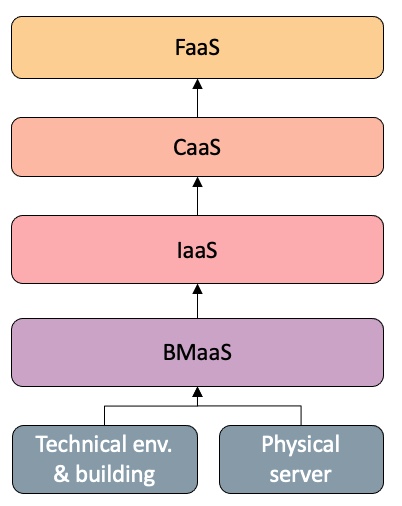
The paper also provides a detailed analysis of the influence of these parameters on the resulting multi-criteria environmental footprint.
By demonstrating how altering these assumptions drastically changes the results, the authors highlight the urgent need for more standardised, transparent methodology based on physically representative data to ensure that environmental claims regarding cloud services reflect the complex reality of shared infrastructure.
Key findings: how infrastructure parameters dramatically alter results
The paper’s sensitivity analysis demonstrates that infrastructure parameters critically influence results.
Infrastructure Features Impact
When modelling load rate, spare rate, and overhead versus omitting them, the impact difference is significant.
For example, with default parameters, CaaS instance impacts can more than double.
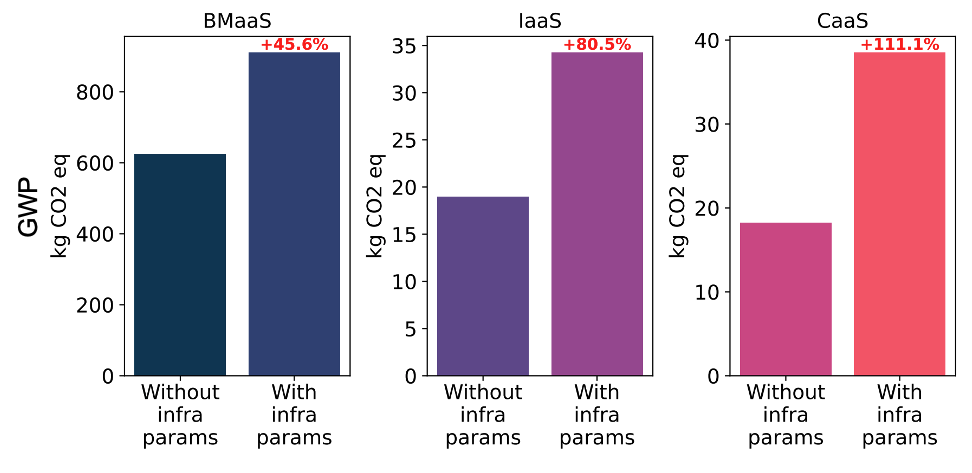
- +45.6% additional impact at the BMaaS layer
- +80.5% additional impact at the IaaS layer
- +111.1% additional impact at the CaaS layer
Another example:
Consider two servers: a single-socket server and a dual-socket server with twice the CPU, RAM, and disk capacity (Figures 1 and 2). Despite offering twice the resources, the dual-socket server has less than double the impact at the BMaaS level for both GWP and ADPe indicators, resulting in lower impacts for equivalent IaaS, CaaS, and FaaS instances. This highlights how underlying physical infrastructure configuration significantly affects upper layer environmental impacts.
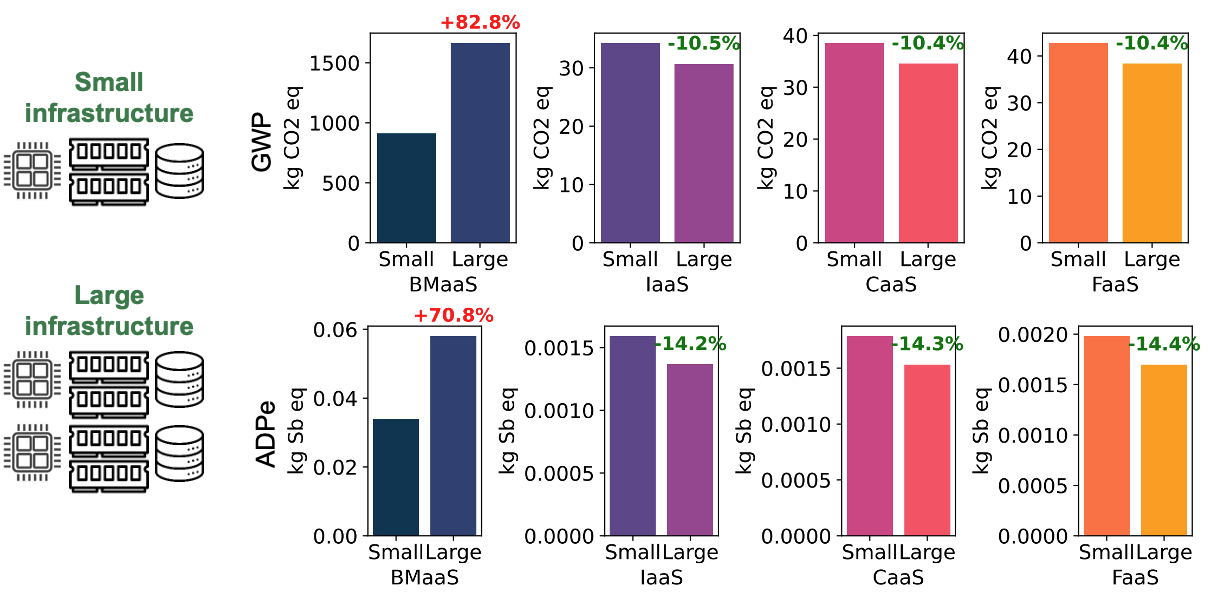
Consequently, incorporating these parameters with representative values is essential for accurate impact estimation of cloud services.
Model Validation
To validate the modelling approach, the authors compared Global Warming Potential (GWP) results with two tools: BoaviztAPI and Tailpipe.
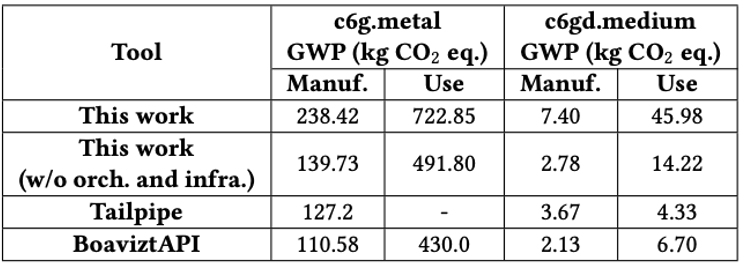
The model yields higher impacts because it considers a broader scope encompassing load rate, overhead, spare rate, datacentre technical environment, and orchestration infrastructure.
If these parameters are not modelled, the methodology provides results in the same order of magnitude as the other tools for BMaaS and IaaS services. The only exception concerns the use impact of the AWS
c6gd.medium instance.
Indeed, the results obtained without modelling infrastructure parameters are still between 2 and 3.5 times higher than BoaviztAPI and Tailpipe. The difference is mainly due to the absence of Power Usage Effectiveness (PUE) in BoaviztAPI’s computation and a difference in the estimated power consumption of the instance. The larger difference with Tailpipe’s result is mainly explained by a ratio of almost 2 between electricity grid mix values considered for the UK
Why this paper stood out: the HotCarbon 2026 Best Paper Award
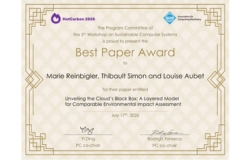
The HotCarbon 2026 committee recognised this work because:
🏆 “Takes initiative on standardizing cloud-impact assessment in a space with no binding standard, with a well-chosen functional unit, likely to spark discussion at the workshop and follow-on work
🏆 Recursive layered allocation from BMaaS to FaaS is novel, and the model explicitly accounts for often-ignored infrastructure factors (PUE, load rate, virtualization overhead, spare rate, data-center technical environment).
🏆 Sensitivity analysis is rigorous and the high deltas at higher layers are valuable for practitioners.”
How to apply these insights today
The described model is deployed in production in Resilio Database for users to estimate, compare, and optimise their cloud use in terms of environmental impacts.
Conclusion: a new era for Cloud sustainability
The authors’ layered model provides a transparent, standardised approach to assess the environmental footprint of cloud services, accounting for abstraction layers, load rates, overhead, and infrastructure parameters.
This work enables:
✅ More comparisons, supplier agnostic
✅Data-driven optimisations
✅ Eco-design of cloud-based services.
✅ Compatibility with an extension to GPU resources with an allocation by units.
Finally, it allows verifying cloud providers’ statement that public cloud is greener than on-premise data centres
What’s next?
The authors are already working on the next improvement to the modelling, with the inclusion of the GPU’s (Graphic Processing Unit) which will open the door to more eco-design of Saas solutions and to estimate the environmental impacts in AI servers.
Stay tuned!
🔗 Read the full paper : Download Here (PDF)
🔗 Explore Resilio Database : link
👉 Contact our experts here
This article was co-written by Vanessa Decostaire & Marie Reinbigler