Introduction
The Netherlands stands as one of Europe’s most digitally advanced nations, with 98.5% household internet connectivity and a central role as a European connectivity hub, thanks to the Amsterdam Internet Exchange (AMS-IX). However, this digital maturity comes with a significant environmental cost. A recent study, quantifies the full life cycle environmental footprint of Dutch Information and Communication Technologies (ICT) in 2024. The findings reveal urgent areas for intervention to align digital growth with sustainability goals.
This article explores the key results, methodologies, and recommended interventions from the study, offering actionable insights for policymakers, businesses, and consumers.
Key findings: 🇳🇱 the environmental footprint of dutch ICT
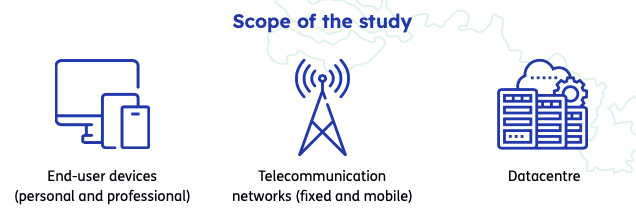
The study, conducted by TNO and Resilio, assesses the environmental impact of Dutch ICT across end-user devices, telecommunication networks, and datacentres. The results are stark:
Impact overview
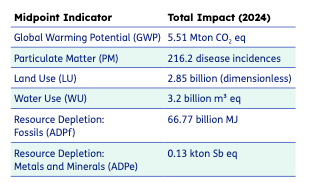
Impact split per indicator across tiers
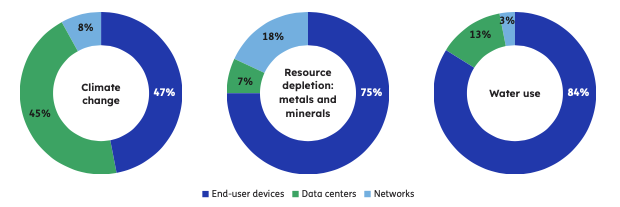
- End-user devices (e.g., smartphones, smart TVs) dominate metal depletion and land use, with smart TVs alone contributing 6.5% of the total ICT CO₂ footprint.
- Datacentres are the second-largest contributor, driven by electricity consumption (37% of total ICT climate impact) and server production (7.5%).
- Networks have the smallest footprint but still contribute to metal resource depletion.
Did You Know? The average Dutch resident’s ICT use (personal and professional) generates 307 kg CO₂ eq annually, accounting for 31% of the sustainable carbon budget per capita.
Methodology: a hybrid Life Cycle Assessment (LCA)
The study employs a hybrid LCA methodology to capture both consumption-based (end-user devices) and production-based (networks and datacentres) perspectives.
- Scope: All hardware and infrastructure used in the Netherlands in 2024.
- Indicators: Six midpoint indicators, including Global Warming Potential (GWP), resource depletion (metals, fossils), particulate matter formation, land use, and water use.
- Data Sources: Collaborative effort with TNO, CBS, ACM, Dutch Datacenter Association, RVO, SDIA, and major network operators, leveraging databases like Resilio Database, CODDE, and Ecoinvent.
The 4 Key Interventions to reduce ICT’s environmental impact
The study identifies four high-impact interventions that could reduce the total ICT CO₂ footprint by up to 15% while addressing the three pillars of the EZK Action Programme: CO₂ emissions, critical raw material dependence, and energy use.
1. Extend device lifespan by 0.5 Years
- Impact: Reduces GWP by 4%, metal/mineral depletion by 7%, and water use by 6%.
- How? Enforce right-to-repair regulations, extend software support, and raise consumer awareness about device longevity.
2. Optimise datacentre server utilisation
- Impact: Raising server utilisation from 15-40% to 75% could cut climate impact by 5%.
- How? Consolidate servers and align electricity use with daily traffic patterns (e.g., AMS-IX).
3. Reuse waste heat from datacentres
- Impact: Capturing waste heat (up to 4.8 TWh annually) could reduce climate impact by 2% and lower fossil energy dependence.
- How? Integrate datacentre waste heat into local heating networks, leveraging the Netherlands’ high population density.
4. Align datacentre utilisation with traffic patterns
- Impact: Adds 3% reduction in climate impact by matching electricity use to real-time demand.
Combined Potential: These interventions could achieve a 15% reduction in CO₂ eq, 17% in fossil resource dependence, and 7% in metal/mineral depletion.
Recommendations for a sustainable digital future
To turn these findings into action, the study recommends four strategic priorities:
1. Prioritise device longevity
Policymakers should:
- Enforce right-to-repair legislation.
- Extend software support and warranties.
- Promote consumer education on sustainable device use.
2. Mandate datacentre Transparency and efficiency
- Strengthen reporting requirements (e.g., under the Energy Efficiency Directive) to include server utilisation rates and daily consumption patterns.
- Incentivise operators to optimise utilisation to 75% and integrate waste heat into heating networks.
3. Focus on systemic solutions
While user behaviour (e.g., streaming habits) matters, systemic changes, such as hardware durability and datacentre operations, yield far greater reductions.
4. Establish continuous monitoring
- Use this study as a baseline for a national monitoring dashboard (managed by the Netherlands Enterprise Agency, RVO).
- Update data as the grid decarbonises and refine interventions over time.
Why this matters for the Netherlands and beyond
The Netherlands’ digital infrastructure is a European leader, but its environmental footprint is disproportionately high compared to peers like Switzerland (247 kg CO₂ eq/capita) and France (253 kg CO₂ eq/capita). With AI usage and datacentre demand growing, proactive measures are critical to:
- Decarbonise the digital economy.
- Reduce dependence on critical raw materials.
- Align with EU climate targets.
Call to Action
The time to act is now !
Whether you’re a policymaker, business leader, or individual user, you can contribute to a more sustainable digital future:
- Businesses: Adopt circular economy principles for devices and optimise datacentre operations.
- Policymakers: Enforce regulations that extend device lifespans and improve datacentre efficiency.
- Consumers: Choose longer-lasting devices, support right-to-repair initiatives, and advocate for transparent, sustainable tech practices.
Learn More
- Attend the Webinar - June 30th, 2026
- Download the 2 pager
- Read the full study
- Read similar study on the environmental impact of ICT in Switzerland 🇨🇭
Connect with the experts:
Or contact us !