📌 Introduction
Resilio and its partners are investigating the environmental impact of AI
The adoption of AI is accelerating, but its actual environmental footprint remains poorly understood. Existing assessments are based on generic assumptions rather than real-world deployment data.
To address this, in March 2026 Resilio launched the study on environmental transparency in the AI value chain, which brings together around 20 organisations across the entire AI value chain (data providers, data centre operators, cloud providers, AI models and applications providers). The first results are already emerging, and the key findings will be published as open research at the Geneva 2027 AI Summit.
⚡ Why this project?
We needed real-world data to accurately understand the drivers and environmental impacts
Current assessments of AI’s environmental impacts are based on generic assumptions, rather than on real-world use cases.
- Our approach :
- Direct collaboration with organisations across the entire AI value chain
- Linking AI models, usage patterns, infrastructure and environmental impacts.
Our objective: to move from “How much energy does AI consume?” to “What factors determine its impact, and what can organisations do to reduce it?”
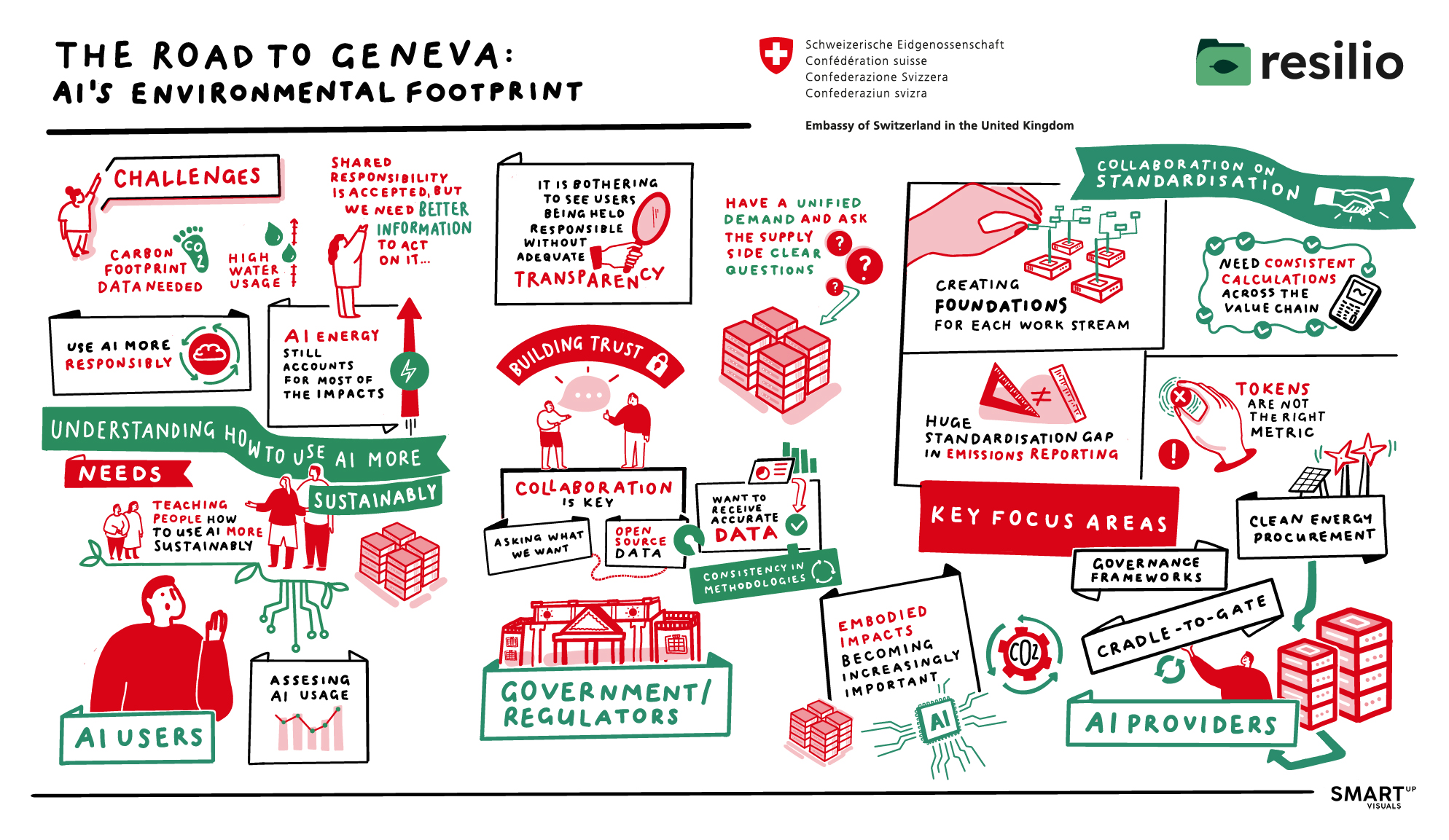
🎯 The project’s ambitions
From research to the publication of a Life Cycle Assessment (LCA) model for AI
- Quantify the environmental impacts of AI throughout its life cycle, enabling comparisons between:
- AI models,
- Deployment options.
- Identify key impact factors and reduction levers (models, hardware, usage).
- Develop a robust methodology and industry benchmarks based on real-world data and case studies.
- Create a practical guide and actionable metrics for CTOs and CSOs.
Publish the results as open research at the Geneva 2027 AI Summit.
🤝 A large-scale project
Close to 20 public and private organisations have signed up to this project
- Institutional partners: ITU, SATW, Sustainable AI Coalition, Swiss Embassy
- Academic partners: Apertus, EPFL
- Private industries: Banque de France, CGI, Exoscale, GRDF, Infomaniak, Liip, Linagora, Meta,Scaleway, Swisscom
🌍 Scope of the project
Geographical and technological scope
Launched in Switzerland, the project is expanding to a European and international ecosystem, with a first focus on Large Language Models (LLMs).
Visit the project website: ai-study.resilio-solutions.com
💡 There’s still time to join the project!
Join the team!
- Co-develop an industry benchmark for the environmental impact of AI and advance environmental transparency together.
- Partners the results before their official publication.
- Partners will be recognised as a contributor at the Geneva 2027 AI Summit.
- Partners will benefit from free support to assess the impact of your AI services.
🤝The project team
Project leads
- Li You, Resilio,
- Louise Aubet, Resilio
- Rosendo Mañas Faura, Resilio
- Tallulah Ritz, Resilio
Partners and contributors
- Agnès Comte (Bank of France)
- Andreas Emlinger (Swisscom)
- Elise Auvray (Scaleway)
- Jean-François Binvignat (Infomaniak)
- Jean-Pierre Lorre (Linagora)
- Jérôme Louradour (Linagora)
- Julia Paolini (EPFL)
- Lisa Rivalin (Meta)
- Manuel Cubero-Castan (EPFL)
- Moritz Werning (Swisscom)
- Oleg Lavrovsky (EPFL Apertus)
- Pierrick Fossez (CGI)
- Simon Shillaker (Exoscale)
- Stephanie Grubenmann (Liip)
Advisers
- Boris Thurm (formerly of E4S)
- Yash Raj Shrestha (Unil.)
- Yuanjun Feng (Unil.)