Key figures: 2.2 Mt CO₂ for Telecom networks in France – analysis and solutions
The French anti-waste law for a circular economy (here in French) requires each telecoms operator to communicate the CO₂ emissions per quantity of data transferred over their network to their consumers. In consultation with Arcep and the main operators, ADEME has developed a methodology for assessing the environmental impact of Internet supply services (here in French). The agency then wanted to test this methodology by working with operators to update it so that it was as easy to use as possible. As well as testing the applicability of the methodology, this study has enabled the first specific study of the impact of networks in France.
In 2022, the impact of the telecoms network in France was 2.2 Mt CO₂ eq, representing 0.4% of France's total carbon footprint. The impact of the fixed network is mainly due to manufacturing, while the impact of the mobile network is mainly due to the use phase. For both types of networks, network access equipment accounts for most of the impact, due to the sheer number of devices. Finally, ADEME proposes practices for reducing the environmental impact of the network, for each third party.
Why evaluate the environmental impact of ISPs? Context and stakes of the AGEC Law
The study was carried out by Resilio in 2023, under the supervision of ADEME, as part of a collective action with Telecom operators (Orange, Bouygues Telecom, Iliad, SFR, Adista and Telecoop).
Context and stakes of the AGEC law for Telecom operators
Telecommunications networks are essential to digital services: they connect all users to each other and to the places where information is stored. Yet they are virtually invisible and relatively unknown to users. They contribute to the impression that digital technology is immaterial, particularly via mobile networks, where electromagnetic waves carry the data. But while the network infrastructure may not be visible to users, because it is managed by the operators, it is very real.
Since 1 January 2024, article 13 of the AGEC law has required telecoms operators in France to communicate to subscribers the greenhouse gas emissions, in grams of CO₂ emitted per kilobyte of data, specific to their network. Each operator must determine this figure using a common methodology provided by ADEME.
Work began at the end of 2020, at the initiative of ADEME, with the main operators (Orange, Bouygues, Iliad and SFR) and Arcep. The first stage involved developing a methodology, based on Life Cycle Assessment (LCA), for modelling and assessing the environmental impact of an Internet Service Provider (ISP). It culminated in the publication of the ISP Product Category Reference (PCR). The methodology was then put into practice through a study of operators' networks.
Aim of the study
Based on the ISP RCP, the study aims to assess the environmental impact of Internet access provisioning in France via fixed and mobile networks. The modelling carried out in the study is based on the aggregation of operator-specific data and specific and generic data from databases (NegaOctet and EcoInvent) and the literature. At the same time, work is being carried out to update the ISP RCP on the basis of feedback received during the course of the study. Finally, this first study will enable us to identify the main areas for action to improve our knowledge of the network. It is also an opportunity to define the additional work that needs to be carried out.
Network: few definitions
There are two main categories of network:
- Fixed networks: these provide access to the Internet from a fixed location via a wired connection (private home, workplace, building open to the public, etc.). They mainly include:
- xDSL technology
- Fibre (FTTx), more recently.
- Mobile networks: these enable wireless equipment to be used throughout the country, transmitting voice and data using radio waves. These systems are known as 2G, 3G, 4G and 5G.
Other technologies exist, such as satellite constellations, but they are excluded from the study because they still represent a small proportion of traffic and very little data is available on the associated environmental impacts.
How to assess the carbon footprint of Internet networks? LCA methodology and study scope
Study scope: fixed and mobile networks in metropolitan France
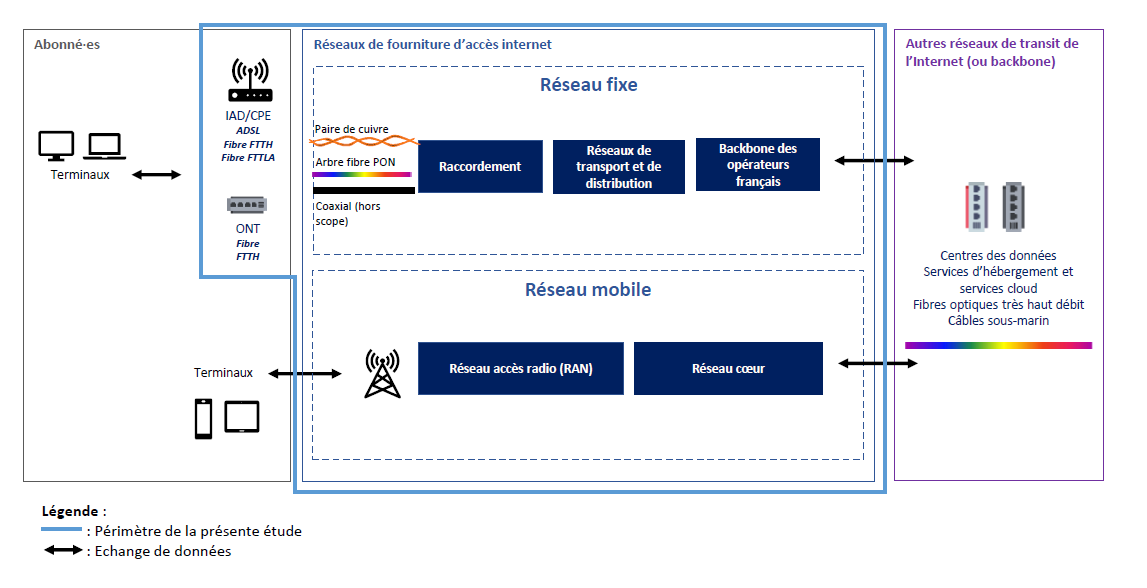
The study is based on metropolitan France, with data for the year 2022. It includes all the network infrastructure managed by French operators, excluding international Internet transit networks (outside the scope), as shown in Fig. 1. It includes:
- For the fixed network: from the subscriber's internet box to the core network,
- For the mobile network: from the antenna to the core network (smartphone not taken into account).
Network equipment and part of the civil engineering (digging trenches, antenna supports, etc.) are also considered. Please refer to the study for more details on the life cycle inventory.
LCA methodology: how to assess the impact across the entire Life Cycle?
This study follows the LCA methodology, considering all life cycle steps (manufacture, distribution, installation, use and end of life) of equipment and infrastructure. Like all LCAs, the study is based on a functional unit (FU). This is the unit of measurement used to assess the service provided. In this study, the FU is:
« Provide Internet access to all users located throughout metropolitan France for 1 year. »
The flow vs flee method : comparison of the approaches
The ISP PCR applies the ‘flow method’ of allocation (paragraph 3.3., in french), which can lead to significant variations in impacts from one year to the next. For this reason, the allocation method generally used in LCA is the ‘fleet method’, which amortises the impacts over the lifetime of the equipment. Both methods are used in the study to compare results. In this summary, only the results of the ‘fleet method’ are presented.
Fixed vs mobile networks: which has the greater impact? Figures and per-subscriber comparison
Environmental KPI’s
For the sake of simplicity, only the indicators for climate change and the extraction of resources, metals and minerals are presented here. - Climate change is expressed in tonnes of CO₂ equivalent, abbreviated t CO₂e, and the indicator is known by the acronym GWP for Global Warming Potential; - Extraction of resources, metals and minerals is expressed in tonnes of antimony equivalent, abbreviated as t eq Sb. This indicator assesses the quantity of mineral and metal resources extracted from nature as if they were antimony; its acronym is ADPe, for Abiotic Depletion Potential (non-fossil).
The study was conducted on 16 environmental indicators.
Fixed network : equals the manufacturing of 29,1 millions of smartphones
To sum up, in France in 2022, the fixed network corresponds to:
- 31.9 million subscribers;
- 68 Exabytes (1018 bytes, 68 million TB) of data consumed;
- A climate change impact of 1.61 Mt CO₂ eq.:
- Greater than the sum of the impacts associated with the health, education and public services sectors combined (1.1 Mt eq. CO₂);
- Equivalent to the direct CO₂ emissions of a fleet of around 1.36 million private vehicles.
- An impact on the extraction of resources, metals and minerals of 76.4 t Sb eq, which corresponds to:
- The manufacture of around 29.1 million smartphones;
- 382 million tonnes of excavated soil.
Mobile network : equals the emissions in CO₂ of 499’000 personal cars
Similarly, the mobile network corresponds to:
- 82.6 million subscribers;
- 11.2 Exabytes of data consumed;
- A climate change impact of 0.59 Mt CO₂ eq, equivalent to:
- 54% of the impact of the health, education and public services sectors combined (1.1 MT CO₂ eq.);
- The direct CO₂ emissions of a fleet of around 499,000 private vehicles.
- An impact on the extraction of resources, metals and minerals of 24.5 t Sb eq, which corresponds to:
- The impact of manufacturing 9.3 million smartphones;
- 123 million tonnes of excavated soil.
Impact distribution by Life Cycle stage
In France as a whole, the fixed network has an average impact 2.3 times greater than the mobile network. However, it carries 6 times more data. What's more, when we look at the breakdown by life cycle stage (Fig. 2 and Fig. 3), the impacts tend to be concentrated in manufacturing for the fixed network and in use for the mobile network.
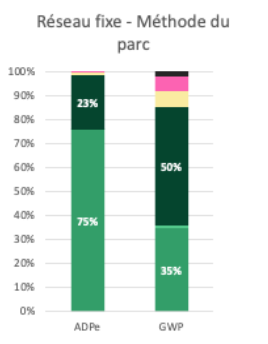
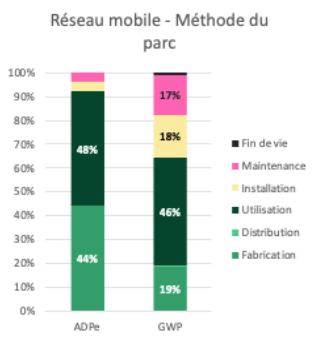
On average, per 1 GB, the mobile network is responsible for 3 times more impact than the fixed network. However, the two types of networks cannot be compared in the strict sense: they do not provide the same service.
Impact per subscriber: how much CO₂ for 1 GB of data
In terms of impact per year and per subscriber in 2022, the study produces the following results:
- On average, on the fixed network, a subscriber consumes 2,290 GB of data and has an impact of:
- 54.1 kg CO₂ eq.
- 2.58 g Sb eq.
- On average on the mobile network, a subscriber consumes 141 GB of data and has an impact of:
- 7.47 kg CO₂ eq,
- 0.31 g Sb eq.
It should be noted that consumption is higher for the fixed network because a fixed subscriber may represent a single person or a household with several users. The unit impacts of the two types of networks are therefore difficult to compare.
As a reminder, the sustainable annual carbon budget per person is between 800 kg CO₂ eq. and 2 t CO₂ eq., depending on the method and objectives applied (Planetary boundaries framework or Paris Agreements).
Network access equipment: why do they account for 80% of the impacts?
For both the fixed and mobile networks, it is the part of the equipment enabling user access to the network that concentrates the majority of impacts for all indicators (> 80%). This corresponds to the local loop (fibre) and internet boxes for the fixed network, and the radio amplifiers (RAN on the diagram) and Base Band Unit for the mobile network. These results can be explained by the very high volume of equipment associated with these categories.
The main results are as follows: - With 31.9 million subscribers consuming 68 Exabytes of data, the fixed network resulted in emissions of 1.61 Mt CO₂ eq. and the extraction of resources, metals and minerals of 76.4 t Sb eq; - With 82.6 million subscribers consuming 11.2 Exabytes of data, the mobile network resulted in the emission of 0.59 Mt CO₂ eq. and the extraction of resources, metals and minerals of 24.5 t Sb eq; - On a global scale, the fixed network has an average impact 2.3 times greater than the mobile network (this figure should be considered in absolute terms, bearing in mind that the two services are different); - It is the equipment used to connect users to the network that accounts for most of the impact for both types of networks and all the indicators.
Evaluation challenges : missing data and approximations in the study
Missing data: which equipment and networks were excluded
This is the first analysis to focus solely on the network in France, or in any other country, using this LCA method. It provides a detailed understanding of the infrastructure and modelling of the network. However, some aspects are less well understood than others and have therefore been subject to approximation or exclusion.
The most important limitations are as follows:
- The exclusion of several categories of mobile equipment due to a lack of life cycle impact data for them. Specific modelling or approximations have been carried out.
- The exclusion of certain types of networks due to a lack of data characterising them, in particular fixed wireless access (FWA) connections and satellite internet access. This underestimates the overall impact of the network.
- Uncertainties over the number of devices and their lifespan due to difficulties encountered by operators in collecting data. Estimates have been used where necessary.
10 key actions to reduce the environmental impact of Internet networks – ADEME recommendations
Through this study, ADEME is proposing ten initial priority courses of action for the State, operators and users to reduce the environmental impact of fixed and mobile networks.
3 key actions for users: reducing data consumption
For users, three actions are proposed:
- Limit data consumption by favouring digital sobriety. The increase in data traffic can lead to the installation or upgrading of network equipment. The most important levers are:
- Reducing online video consumption
- Avoid watching or filming in (very) high definition
- Prioritise text and then photos over video in messages and posts on social networks.
Digital Sobriety
- Reserve mobile networks for uses that require little data. For uses that require a lot of data, use fixed networks instead.
Internet box: why and how to share or turn it off
- Limit the environmental impact of your internet box. More than half of the fixed network's carbon footprint comes from its boxes. There are two effective ways of reducing this impact:
- Increased sharing of boxes
- Systematically switching off the box when it is not in use can halve the impact of its use.
All the recommendations can be found in the full study.
Although the study concerns France, it does provide some interesting pointers for countries with similar network infrastructures (level of deployment of fiber (French article) versus ADSL, for example). But the impact of networks also depends on many other factors, such as population density and distribution, geography, political choices, etc., which will impact the deployment of one network rather than another (fixed, mobile, satellite, etc.), as well as network technology (ADSL or fiber, etc.). Extrapolation is therefore a complex exercise.