The amount of equipment on the market is growing steadily, while the recycling rate is struggling to reach 1% per year. The 2024 global report on WEEE provides a better understanding of the issues surrounding this type of waste.
Introduction: why are WEEE a major issue?
Even though it is usually the manufacturing stage that is responsible for most of the environmental impact, the end-of-life phase of electric and electronic equipment (EEE) flies under the radar. Yet this is a major issue: the mass of equipment being put on the market continues to grow, while the recycling rate is barely increasing, and extracting the elements needed to manufacture them is becoming increasingly complex. As a result, Western societies are piling up resources in landfill sites, that were laboriously extracted (far from us) from the earth's crust, while disserting on the ideal of a circular economy.
What do these quantities of waste represent? What are the associated environmental impacts? Why is the recycling rate so low? Are there any frameworks governing the treatment of this waste? We propose to answer these questions.
WEEE around the world: key figures and trends
Global production of 62 million tonnes in 2022
In 2022, the world population generated 62 million tons (Mt) of e-waste (The global e-waste monitor 2024, UNITAR; most of the key numbers come from this study, otherwise, the source is mentioned). More concretely, if we wanted to load all this waste into 40-tonne lorries, there would be enough to go round the world in a queue (1.55 million 25-metre lorries). Or, to give other illustrations, the e-waste mass generated in 2022 corresponds to 4'133 of the biggest cruise ships (7'000 passengers) and 6'200 Eiffel Towers. Among these 62 Mt, half is estimated to be metals, and a quarter is made of plastics.
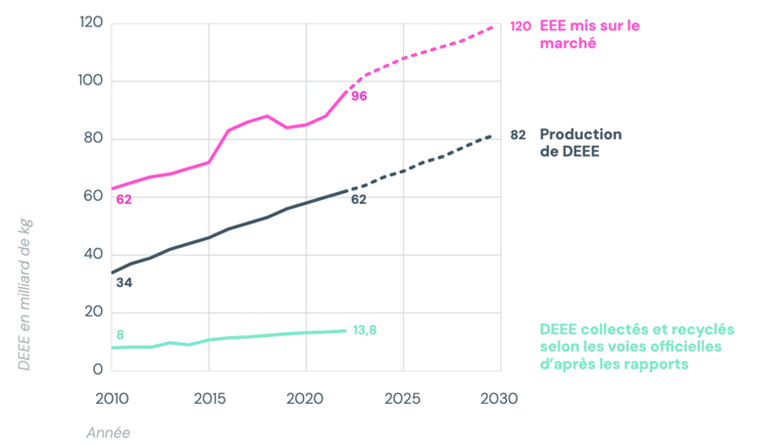
We can see from Figure 1 that e-waste generation is increasing linearly from the first records in 2010, following the trend of equipment mass placed on the market. By 2022, e-waste mass increased by 82% compared with 2010. And it is expected to reach 82 Mt in 2030 (32% growth).
The impact of generative AI on future WEEE production
The increasing use of generative AI (GAI) is likely to push this figure higher than expected. It requires substantial computational resources for model training and inference, implying a significant e-waste flow in a few years. This study, published in Nature, tries to quantify and explore ways of managing the e-waste generated by GAI, with a particular focus on large language models. With a computational power-driven material flow analysis framework, it is estimated that GAI associated e-waste stream could reach between 1.2 and 5 million tons cumulated on 2020–2030 period, depending on the scenario.
Transboundary flows of WEEE: legal and illegal
It also should be mentioned that 5,1 Mt of e-waste is shipped across borders, from which 3,3 Mt (65%) is uncontrolled. Among the controlled transboundary flows, a majority takes place within and into Europe and East Asia, while illegal transboundary movements mainly come from Europe and North America, heading to Latin America, the Caribbean and Africa.
In Europe: 17.6 kg of WEEE per capita per year
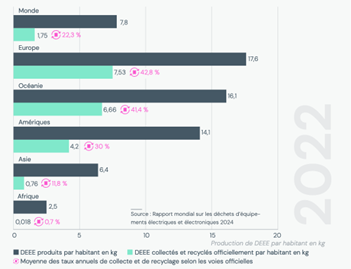
Out of all regions, Europe generates the most e-waste per capita per year with 17.6 kg, followed by Oceania at 16.1 kg and the Americas at 14.1 kg. With 13 Mt of e-waste produced yearly, Europe represents 20% of world production, when only 10% of worldwide population.
The European countries producing the most WEEE
At country level, the biggest e-waste producers in kg per capita are Norway (27), the United Kingdom of Great Britain and Northern Ireland (24), Switzerland (23), France and Iceland (22). Overall, 43% of the 13 Mt European e-waste is documented as formally collected and recycled (5,6 Mt).
How much WEEE is collected and recycled?
Only 22% of WEEE are formally recycled
Only 13,8 Mt of e-waste are documented as formally recycled worldwide in 2022 (Figure 1), representing 22% of the estimated e-waste volume. The remaining is:
- For 26%, collected and recycled outside of formal systems, in upper middle to high-income countries, with developed e-waste management infrastructure. But compliance with environmental standards is not guaranteed.
- For 29%, handled in low and lower-middle-income countries with no e-waste management infrastructure, mostly by the informal sector.
- For 23%, disposed of as residual waste, in landfills or incinerated.
WEEE growth outpaces recycling by a factor of five
Therefore, less than half of the total e-waste volume is treated in proper infrastructures and less than a quarter is handled in an environmentally sound manner. Since 2010, the growth of e-waste generation is outpacing the formal collection and recycling rate by almost a factor of 5.
The challenges of recycling WEEE
Unequal recycling infrastructure across regions
High income countries possess WEEE treatment infrastructures and organisations (For example Swico, SENS eRecycling in Switzerland, Ecologic and Ecosystem in France), financed by the principle of extended producer responsibility: equipment producers pay a tax for equipment treatment when putting them on the market. This enables the management of collection points specific to e-waste. But WEEE policies are not implemented globally – it concerns only 67 countries – and where policies are applied, they are not fully respected. So, e-waste collection and management are a first challenge, explaining the collection and recycling rate variability among regions: Europe and Oceania leading with 43% and 41%, when Asia recycles 12% of its e-waste and Africa does not reach 1% (see Figure 2).
Variable collection and recycling rates across continents
The difficulty of separating and recycling certain materials
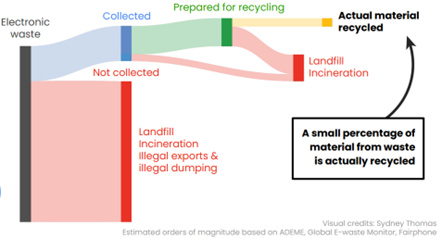
Once the waste is collected, the whole is not necessarily recycled, for various reasons. The different materials that composed the equipment must be separated before treatment and only few elements are financially profitable to recycle. The main recovered elements are iron and copper, present in high quantities. Other metals are present in tiny quantities or in alloy, chemically difficult to separate through energy-hungry processes. Very little proportions of these are recovered, mainly precious metals (gold and palladium). This is why circularity in raw material is very low (Figure 3). For instance, only 1% of rare earth element demand is met by e-waste recycling.
What are the environmental impacts of WEEE?
WEEE recycling: a lever to reduce mining
WEEE recycling is a powerful leverage to reduce mining and associated impacts. Secondary raw materials, recovered from e-waste are mainly copper, gold, iron and palladium, and avoided the excavation of 900 Mt of ore that would have been necessary to obtain these materials. Plus, it has been estimated that recycling these metals avoid the emission of 52 Mt of CO2-eq, compared to primary extraction.
Toxic substances present in WEEE
Not to be neglected is also the fact that WEEE contains refrigerants (CFCs) that have a strong warming potential and contribute to greenhouse effect but also brominated flame retardants, mercury and other toxic and persistent substances that have an impact on health and the environment.
Underestimated impacts: human toxicity and ecotoxicity
So, on the one hand, environmentally sound management of e-waste reduces significantly the environmental impact. But, on the other hand, proper management is not the fate for most of e-waste volume. And overall, end of life impacts of EEE are usually overlooked: they are considered too low to be relevant in impact analysis, as detailed in this review from 2024 about end-of-life modelling in digital equipment. This work also highlights that the hypothesis and methods used to quantify end of life impacts are very optimistic, leading to almost systematic underestimation of environmental impacts (recycling rate, substitution approach and avoided impacts approach). Thus, this stage of life cycle equipment should be studied more rigorously in LCAs, so that its environmental burden can be estimated more accurately. Because, for certain categories of impact, such as human toxicity and ecotoxicity, the end-of-life phase is more than relevant.
Regulations and legal frameworks for WEEE management
The ecodesign for sustainable products regulation in the EU
The Ecodesign for Sustainable Products Regulation (ESPR) is a package of measures that will replace the Ecodesign Directive. It implies among other things longer-term updates for operating systems (minimum of 5 years), promotion of repairing, reusing and reconditioning (Directive on repair of goods) and a product passport mandatory for every equipment. The implementation of the first rules will start in July 2025 and should help to extend the life of equipment and therefore reduce the amount of waste.
The Basel convention: framing transboundary movements of WEEE
The Basel convention is an international multilateral environmental agreement signed by 187 countries (missing the USA), that prohibits transboundary movements of WEEE, except when:
- exporting allows to increase the share of recycling or conditions of waste management on health and the environment.
- the importing country formally agrees to the transboundary movement.
This text implies heavy administrative processes and is blamed to slow down cross-border movements of products defined of potential significance in terms of promoting the implementation of a circular economy. However, equipment declared as functional is not subject to the convention and thus can be easily exported, allowing uncontrolled transboundary movement.
The waste shipment regulation in the EU
At the European Union (EU) level, the Waste Shipment Regulation (WSR) frames the transboundary movement of waste within, into, and out of the EU and ensures it is managed in an environmentally sound manner. It also aims to prevent the illegal trade of e-waste by prohibiting exportation to non-EU countries. Nevertheless it is estimated that around 2 Mt of WEEE illegally leave Europe each year (Zoetman 2006). Thus, to distinguish between e-waste and functional equipment, the EU Directive on WEEE has established certain criteria that functional equipment must meet to be declared as such (proof that it is functional, sold and not waste, and that it was sold).
What are the levers to reduce the amount of WEEE ?
Reducing the amount of electrical and electronic equipment used
To reduce e-waste volume, measures can be taken at each step of the equipment's life cycle. Of course, making sure the waste is correctly disposed is one solution, but before that, the most efficient lever is to reduce the amount of EEE we use, then favour reusing and if not possible discard it in a collection point specific for this equipment, to make sure that components that can be are recycled, and that toxic compounds are safely treated.
Promoting reuse and refurbishment
Corporations can put their equipment, that have reached the end of the guarantee period but are usually still working on the second-hand market. Specialised entities like the re-useIT service from SPIE (Switzerland) and Emmaus connect (France) for digital workplace, or like Evernex for datacentre hardware, are able to collect equipment to give it a second life. As refurbished market is growing, companies now also have the possibility of furnishing themselves on this market, with new companies like Reuse IT (France), able to provide a certain amount of equipment, intended for companies, that are respecting all necessary cybersecurity and performance characteristics.
Using spare parts to extend the lifespan of equipment
Another option is to keep the equipment longer, after that guarantee period ends, and use functional spare parts from broken material to fix other equipment. This is more interesting for big organisations, when an internal service for IT management and repair is relevant.
Developing more efficient recycling methods
Eventually, to increase the amount of recycled material, we need to develop efficient and affordable ways to recover the different elements present in e-waste. For example, Japan, which is a major manufacturer of electronic products but has no mining resources of its own, is currently carrying out a large amount of research into recycling (here in French) these materials. Companies such as Hitachi and Mitsubishi Electric are involved in the recycling effort, the former in the recycling of magnetic components and the latter in the recycling of metals commonly found in WEEE and plastics.
For more details about everything mentioned, The global e-waste monitor 2024 is the most complete document to date.